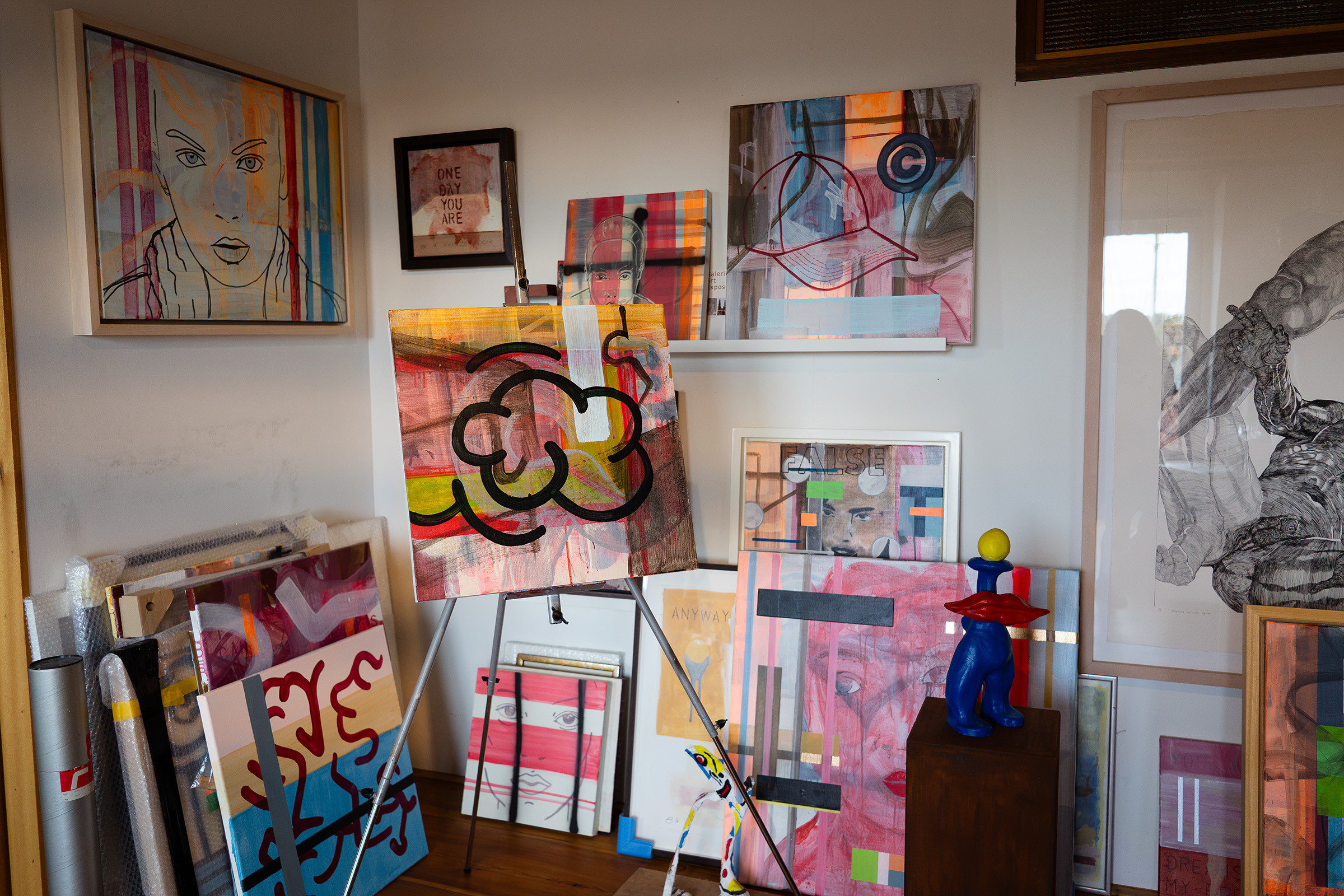
My first encounter with Eelco’s paintings was during my visit at StartDock a few months ago, when I went for a personal tour with Jasha from Novus Arte. He was one of the artists that stayed with me after I left the exhibition. I was intrigued by the mix of shapes, layers and words, and I wanted to talk to him about all of it, to find out more about the meaning and the man behind them. Especially after I found out that Eelco is also a successful real estate entrepreneur, and I am fascinated by people who move through various work fields. Being one of them and constantly struggling to find the right balance, I like talking to others about how they do it.
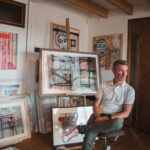
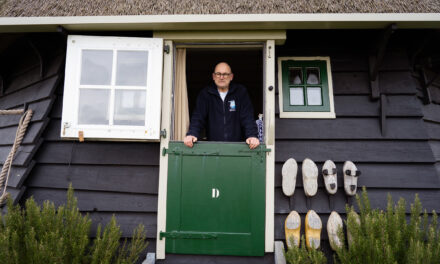
He invited me to his studio in Monnickendam, where I had the chance to see how he works and we talked for hours about art, life, sport, real estate and Dutch history. We browsed through some of his art, and he showed me what he was selecting for his next exhibition. He also proudly showed me the work by other artists that he had collected for his home, the six bikes that were waiting for the next trip, and how he trains for skating. The entire space seemed to breathe art through all its pores and it was very inspiring.
Like a lot of multihyphenates, Eelco never actually chose. He graduated in 1994, went straight to work for one of the largest real estate companies in the world, and painted alongside it. What he did believe, for a long time, was that the two worlds had to stay separate. After a successful solo exhibition in Amsterdam in 1999, he stepped away from the commercial art scene, though not from painting. He kept making art without deadlines, trends or a market to please. It took years, and a nudge from a good friend, before he understood that combining the two was his strength.
Today, Eelco pursues his painting more publicly, exhibiting and selling again, and also runs a real estate company called Estadium, where he develops everything from single buildings to whole urban areas. Among their projects are Hamerkop in Amsterdam and the restoration of historic buildings such as De Adelaar in Wormerveer. He is also regularly involved in major cultural projects, such as the Zamu Museum in Zaandam, which is set to become one of the largest contemporary art museums in Europe.
He is a great storyteller and I wish I could have recorded the entire interview for you, but it would have been a very long read, so I have kept to the highlights.
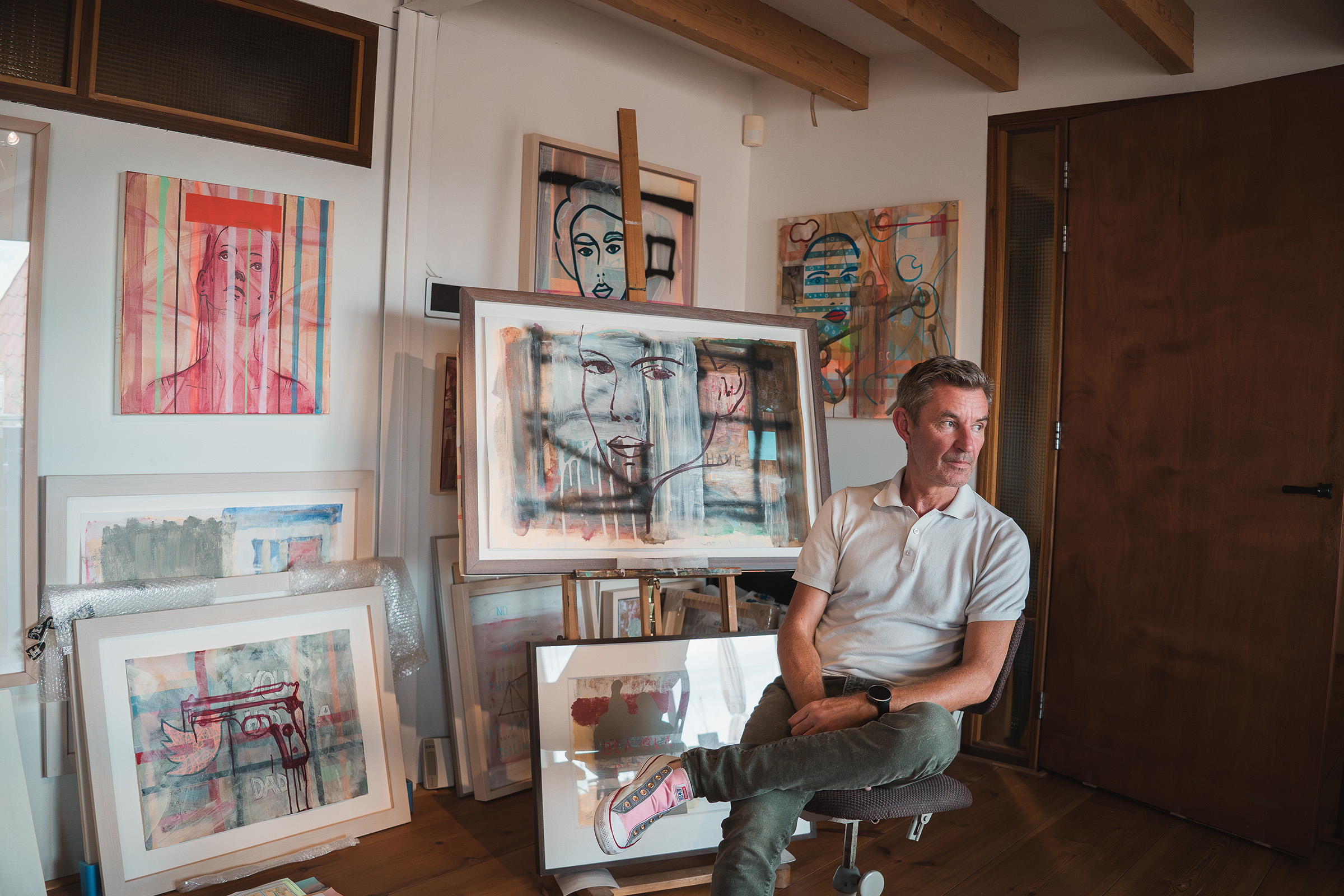
1. Hi Eelco, thanks for agreeing to this interview! Could you tell me a bit about yourself?
Eelco: I was born in 1969 in Zwanenburg and today I live and work in Monnickendam, in the Amsterdam Metropolitan Area. Depending on the context, I describe myself as an entrepreneur, a visual artist or a sports enthusiast. But in reality, those identities are closely connected.
Through my company Estadium, I work on real estate projects ranging from individual buildings to larger urban areas. As an artist, I make paintings, drawings, sculptures, texts, furniture and occasionally architectural designs. Sport has always been an important part of my life as well. I cycle, skate, sail, ski, play tennis and run, almost always outdoors.
The common thread is movement: physically, mentally and creatively. I like making things happen, exploring possibilities and bringing together elements that initially seem incompatible. Structure and spontaneity, business and imagination, physical effort and reflection: I need all of them.
2. You are a painter, but you also work in real estate and have a strong connection with cycling and sport. When someone asks you at a party what you do, which answer comes out first?
Eelco: It depends on who is asking, although I usually say that I am an entrepreneur and an artist. If I mention real estate first, people sometimes assume that art is a hobby. If I say I am an artist, they are surprised to hear that I also develop buildings and urban areas. Apparently, we like people to fit into one clearly defined category.
For a long time, I also thought these worlds needed to remain separate. I graduated in 1994 and started working for one of the largest real estate companies in the world. It was a formal environment: wearing the wrong socks could already count against you. Creativity was appreciated mainly when art was considered an investment. It was not something you discussed as part of your personality or professional approach.
Years later, a good friend helped me realise that combining creativity with serious commercial expertise was not a weakness but a unique strength—something I should show rather than hide. Today, the boundaries have largely disappeared. I exercise with business relations and talk about art with them. A conversation during a bike ride can move quite naturally from a real estate project to a painting.
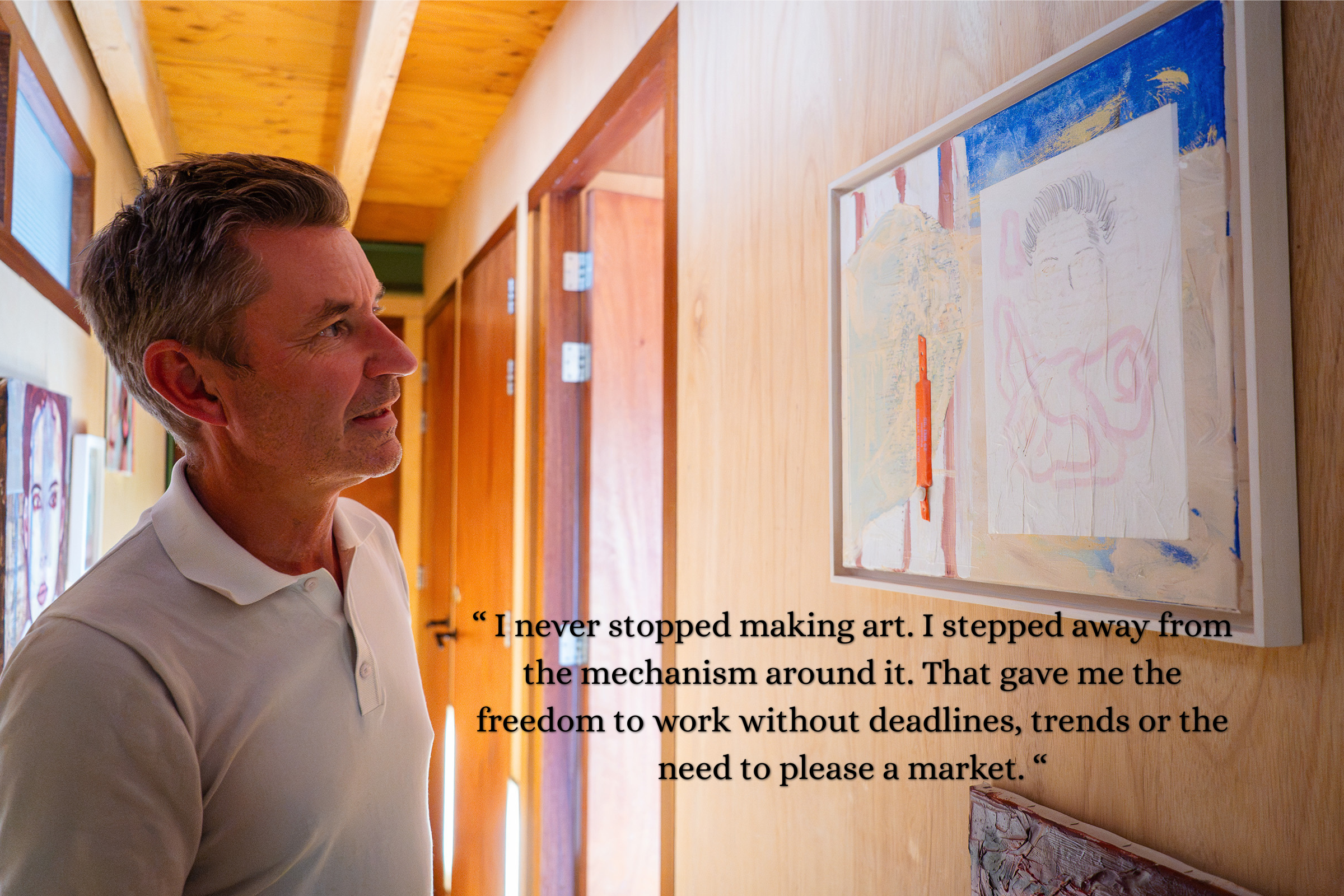
3. You had a solo exhibition in Amsterdam in 1999 and then stepped away from the commercial art world. What made you take that decision?
Eelco: The exhibition in 1999 was successful, but it also made me aware of the expectations surrounding the commercial art world. Once people recognise a certain style or type of work, there can be pressure to repeat it. I did not want to become a manufacturer of my own success.
I never stopped making art. I stepped away from the mechanism around it. That gave me the freedom to work without deadlines, trends or the need to please a market. Sometimes a work developed quickly; sometimes it remained unfinished for years.
That distance changed my relationship with art. It became more personal and perhaps more honest. I could allow the work to evolve alongside my life, without constantly having to explain or sell it. Returning to exhibitions later therefore felt less like a comeback and more like opening the doors again.
4. I first came across your work at the StartDock exhibition and noticed the recurring symbols. Tell me about them.
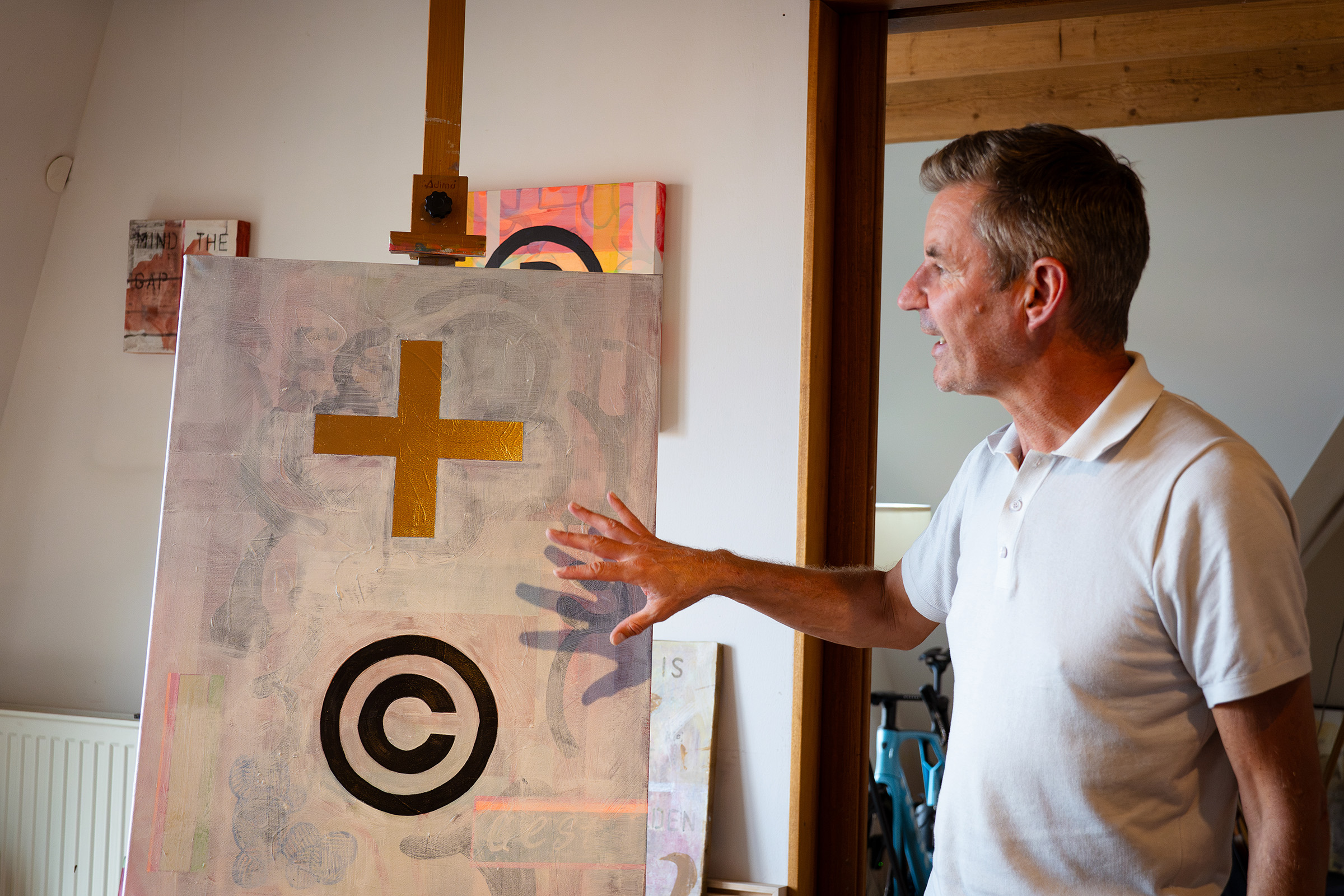
Eelco: My visual language contains symbols that return almost unconsciously. The dot, for instance, can represent focus, a beginning or an ending. It is the smallest possible gesture, but it can also become the centre around which everything else revolves.
The square often represents a stage, a room, a frame or a threshold. We organise much of our lives in squares and rectangles: houses, windows, streets, screens and paintings. They give us structure, but they can also confine us.
I like that symbols can be simple and ambiguous at the same time. I do not want to dictate one interpretation. They are invitations. Viewers bring their own memories and experiences, so the same symbol can feel comforting to one person and unsettling to another.
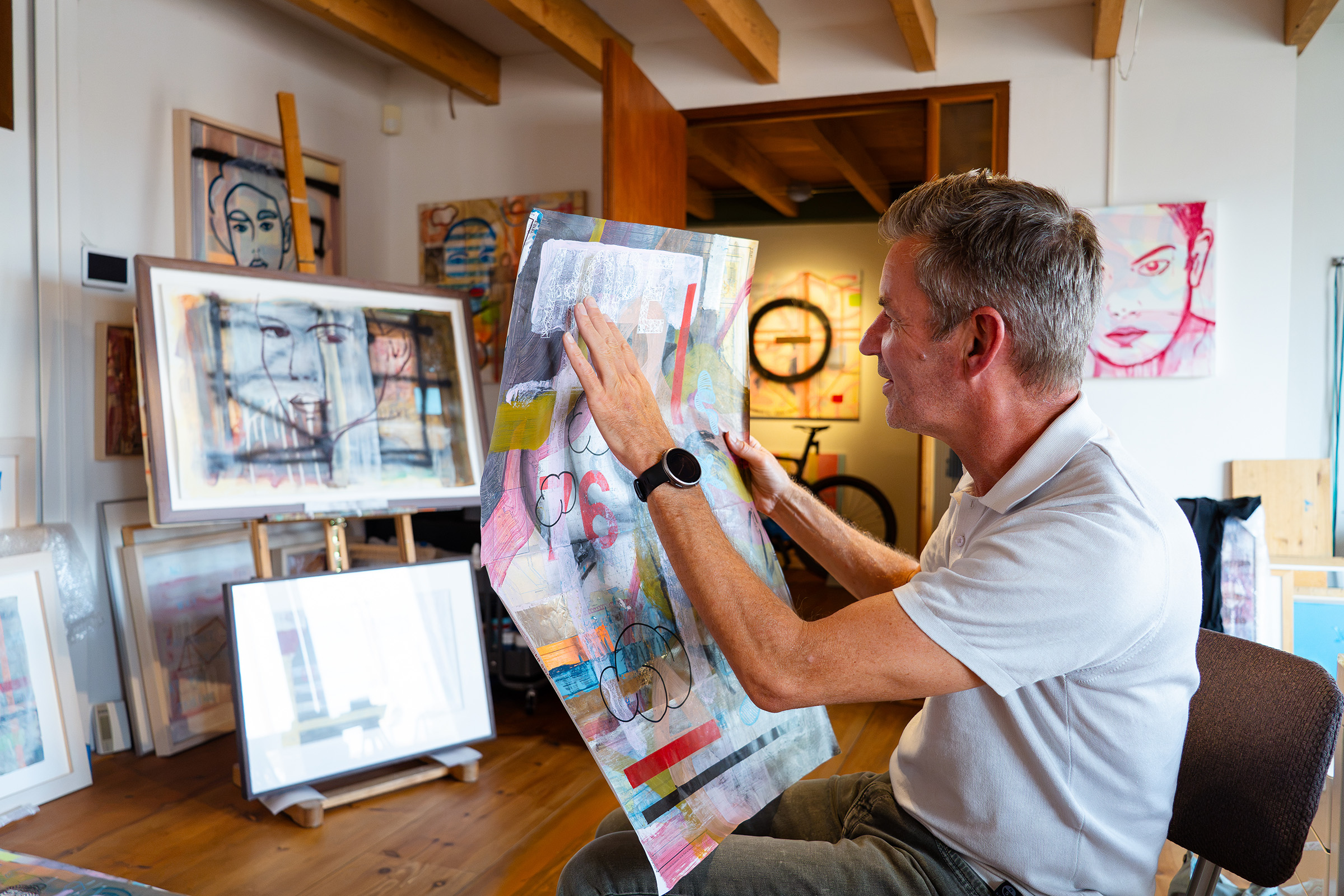
5. There are a lot of female faces and figures in your work. What draws you back to the human figure, and particularly to women?
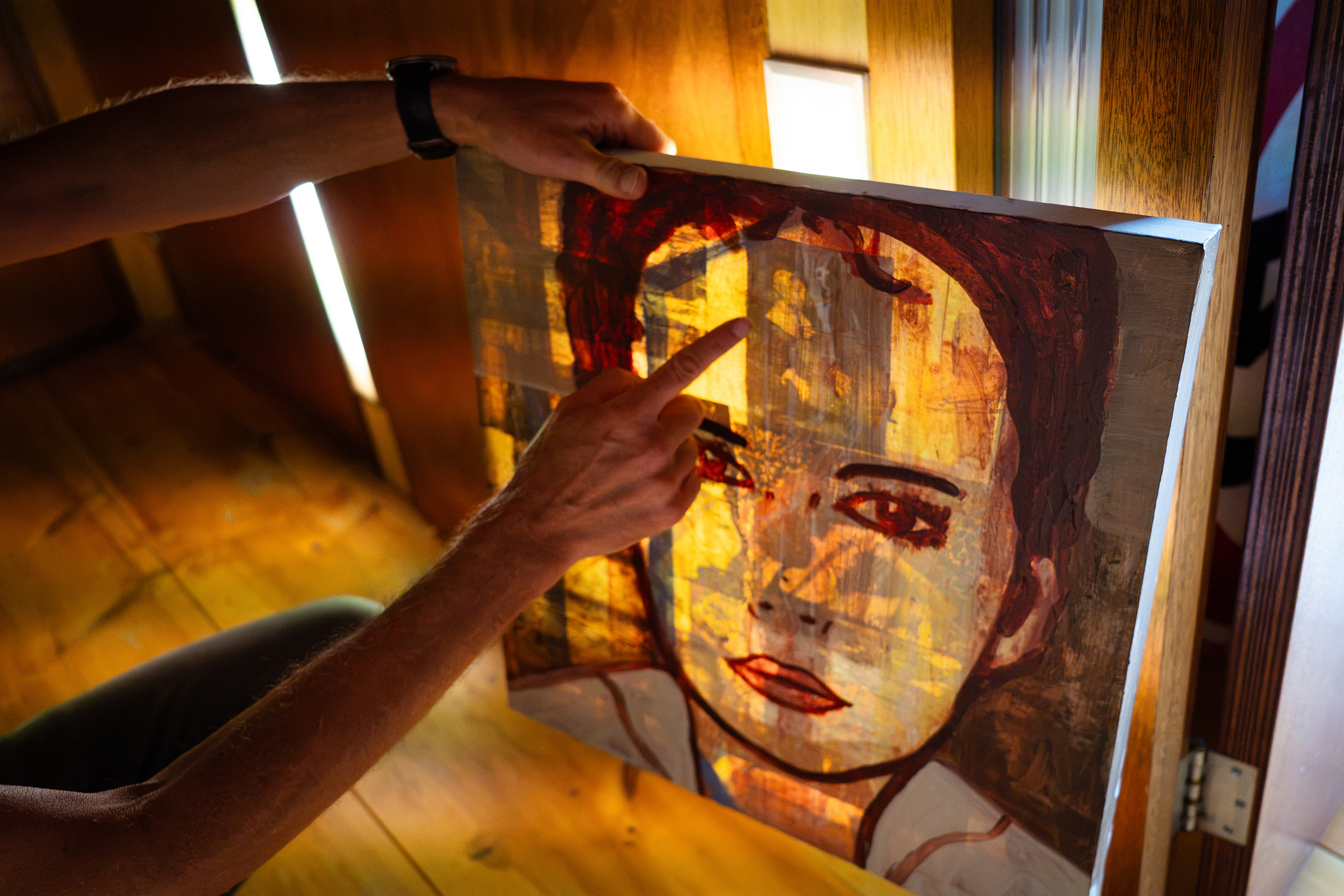
Eelco: The human figure is endlessly expressive. A face can communicate vulnerability, strength, desire or distance without saying anything explicitly. I am not interested in creating conventional portraits. The figures in my paintings are often a mixture of observation, memory, imagination and emotion. Women recur because, in my visual world, they represent life, love, intimacy and relationships. But they are not illustrations of one particular person. They become characters or presences that carry a feeling.
I am interested in what is revealed and what remains hidden. Sometimes a face is direct and almost confrontational; sometimes it partly disappears under paint, lines, symbols or text. That tension reflects how we experience other people. We can feel very close to someone and still never fully know them.
6. You also work with text and words. Do words come to you in the same way images do?
Eelco: Words and images often arrive at different moments. An image tends to begin as an atmosphere, a movement or a visual tension. Words are more precise, but they can also disrupt that image or send it in an unexpected direction.
Sometimes a word is almost like a found object. I hear it in a conversation, read it somewhere or write it down without immediately knowing why. Later, it may find its place in a painting. I do not use text to explain the image. Ideally, it complicates and deepens it. A word can create a second narrative or introduce irony, tenderness or doubt. I like it when the viewer begins to wonder whether the text belongs to the figure, to the artist or perhaps to themselves.
7. Who or what has influenced your work over the years?
Eelco: People often assume that nature or the landscapes I encounter while cycling, skating or sailing are my main sources of inspiration. Being outdoors certainly gives me energy, but it is rarely the direct source of my work.
Music is much more important. I always paint with music, and what I listen to ranges widely. Music can change the pace of a brushstroke, the atmosphere in the studio and even the direction of a painting. It reaches an emotional layer before language or rational thought takes over. My other major source is human interaction: observing people, talking, listening and actively participating in life. I am interested in what happens between people, what they reveal, what they conceal and what remains unspoken.
Of course, the shapes of cities, landscapes and architecture enter my work subconsciously because they form the world in which I move. But I have never tried to copy reality. Reality cannot truly be copied; you have to go there, see it and experience it for yourself. In my work, I try to capture something deeper about that experience through words, images and colour.
8. When you start a painting, do you usually know where it is going?
Eelco: Usually, I know how I want to begin, but not where the painting will end. I might start with a colour, a face, a geometrical form or a sentence. After that, the work begins to respond. Painting is a conversation. You make a decision, look at what has happened and then react. Sometimes the best part of a work emerges from something that initially seemed like a mistake. If I knew the final result in advance, there would be little reason to make it.
That does not mean the process is random. Experience gives you an internal compass. You recognise when a work needs more energy, more silence or simply time. The difficult part is knowing when to intervene and when to leave it alone.
“Working in real estate has taught me to look at the social, economic and practical layers of a place. Being an artist encourages me to look beyond square metres and spreadsheets. I am interested in identity, atmosphere and the emotional effect a building has on people. Sometimes the most valuable element is precisely the part that appears inconvenient: an old industrial detail, an unusual proportion or a trace of the past.
Creativity and commercial or technical expertise are not opposites.”
9. You describe your work as a tension between geometry and freedom. Which side wins more often?
Eelco: Freedom usually has the final word, but it needs geometry to push against.
Geometry gives me structure, just as architecture, planning and financial frameworks do in real estate. A square, grid or line creates order. But once that order exists, I want to disturb it. I introduce an intuitive gesture, a human figure, an imperfect line or an unexpected colour. Complete freedom can become arbitrary, while complete control can become lifeless. The interesting area lies between the two. That balance is present throughout my life. I enjoy creating structure, but I also need enough room for surprise and discovery.
10. Has working in real estate changed the way you look at buildings, streets and cities? And has being an artist changed the way you approach development projects?
Eelco: Absolutely. A building is never just an object. It contains the ideas of its architect, the ambitions of its owner and the memories of everyone who has used it. Working in real estate has taught me to look at the social, economic and practical layers of a place. Being an artist encourages me to look beyond square metres and spreadsheets. I am interested in identity, atmosphere and the emotional effect a building has on people. Sometimes the most valuable element is precisely the part that appears inconvenient: an old industrial detail, an unusual proportion or a trace of the past.
Creativity and commercial or technical expertise are not opposites. Creativity can help you see an opportunity before it is obvious, while professional discipline makes it possible to realise that idea. Good development is not simply about replacing the old with the new. It is about recognising what already has meaning and finding a new future for it.
11. When you walk through Amsterdam, do you look at it as an artist, a developer or simply as someone who lives here?
Eelco: All three perspectives are active at the same time. As a developer, I notice unused buildings, changing neighbourhoods and places where the city could function better. As an artist, I notice compositions, human interactions and the contrast between order and unpredictability. As someone connected to the city, I also notice what development does to everyday life. Amsterdam should not become too polished or predictable. Its imperfections, contrasts and unexpected encounters are part of its character.
I am particularly interested in transitions: where an industrial area meets a residential neighbourhood, where an old façade hides a completely new interior, or where different groups of people briefly share the same space. Those in-between areas often tell you more about a city than its most famous buildings do.
12. You have worked on some interesting real estate projects. Which one are you most proud of?
Eelco: ZAMU is the project I am most proud of because everything comes together there. The team, the owners, the historic buildings, the art and the artists form a unique combination. It is perhaps the most complete and meaningful project I have ever worked on.
ZAMU is being created within the extraordinary industrial landscape of the Hembrug site in Zaandam. The challenge is not simply to develop buildings, but to create a place where art, culture, heritage, architecture, landscape and entrepreneurship strengthen one another. Projects of this scale can only succeed when the people involved share a vision and are prepared to look beyond their individual roles. The museum, the buildings and the garden are important, but ultimately it is the total experience that matters. ZAMU brings together my work in real estate, my love of art and my belief in the power of creative environments. In many ways, it represents everything I have been working towards.
13. You eventually returned to exhibiting your artistic work. What are your plans for the future?
Eelco: I want to continue exhibiting, but I am still searching for the ideal way to present the layered nature of my work. A painting does not exist in isolation. For me, its title, the image and the right music could form a single experience: what you see, what you hear and what you feel, including everything that remains suspended between those elements.
That space between the viewer and the work is essential. When an artwork makes you turn inward and discover something personal, the experience can remain with you forever. That is where art acquires its real meaning. It can offer energy, support, vision or balance, often without being able to explain exactly how.
Future exhibitions could therefore bring paintings, drawings, sculptures, text and music together. I do not want to explain everything to the viewer. I want to create the conditions in which something can happen.
14. When is the next exhibition?
Eelco: There are two exhibitions coming up. The first is in Alkmaar in October and it has the title “Connecting the World Through Art”. This is an international exhibition that uses art as a catalyst for connection, dialogue and cultural exchange, organized by Hogeschool Inholland and Novus Arte. It will take place in the Kapelkerk in Alkmaar on 29, 30 and 31 October. The second one is a larger solo exhibition in Amsterdam at a unique and spectacular location. However one of the most unique places where my work was shown over the past months was Times Square in New York.
15. Is there a work you would never sell? Why that one?
Eelco: There are actually several works I would never sell. Simply because those are so close to me. They mark periods of my life that I always want to keep nearby, and that makes them deeply personal. One example is a work I made in 1995. It contains the wristband I wore to an extraordinary, intimate Rolling Stones concert at Paradiso. I had just graduated, started working, was still painting a lot and major changes in life were approaching. Life was really beginning to accelerate.
That entire period is contained in the work: the excitement, the uncertainty and the sense that everything was about to open up. It is more than a record of a memory. It is part of me—a mirror. That is why it can never leave.
Eelco van Loenen
Monnickendam, August 2026